PBI

About
What is the PBI?
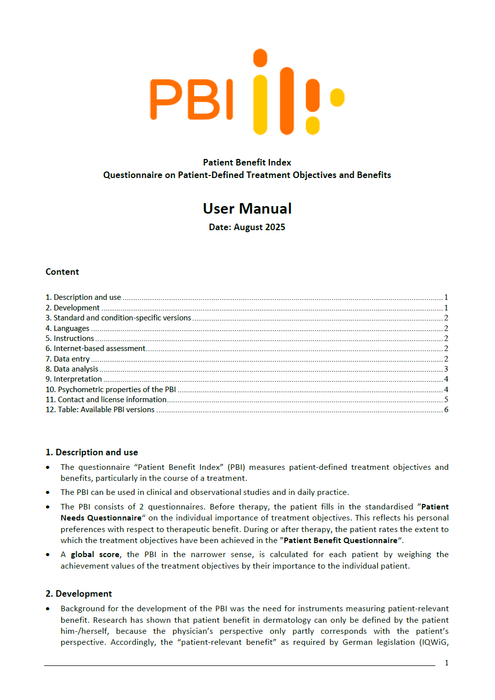
The questionnaire “Patient Benefit Index” (PBI) measures patient-defined treatment objectives and benefits, particularly in the course of a treatment.
The PBI can be used in clinical and observational studies and in daily practice.
The PBI consists of 2 questionnaires
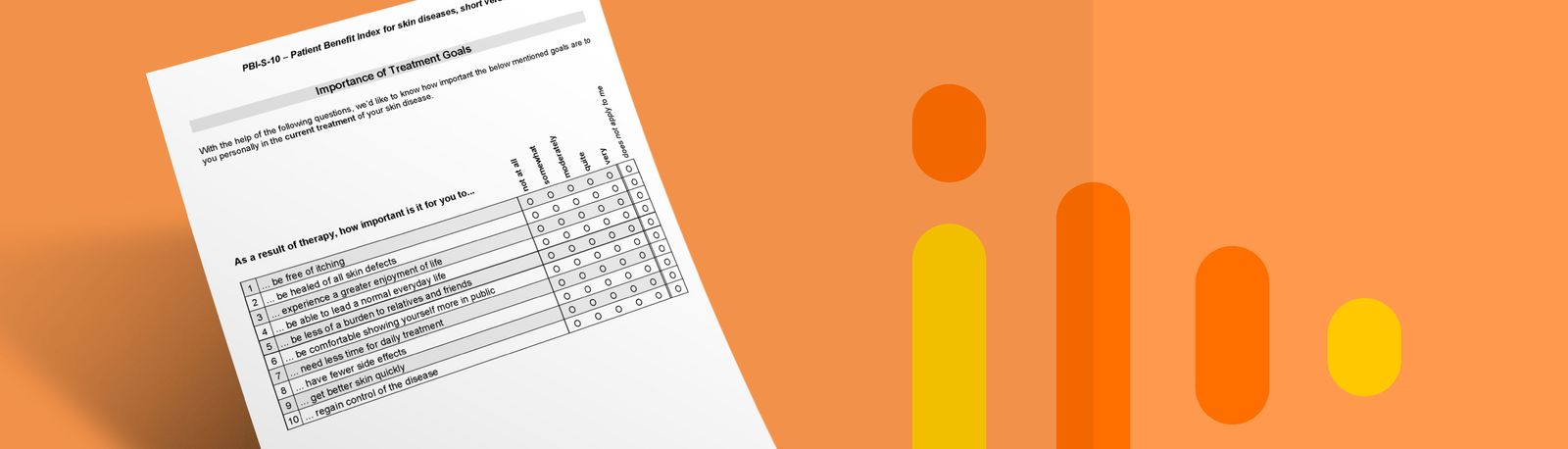
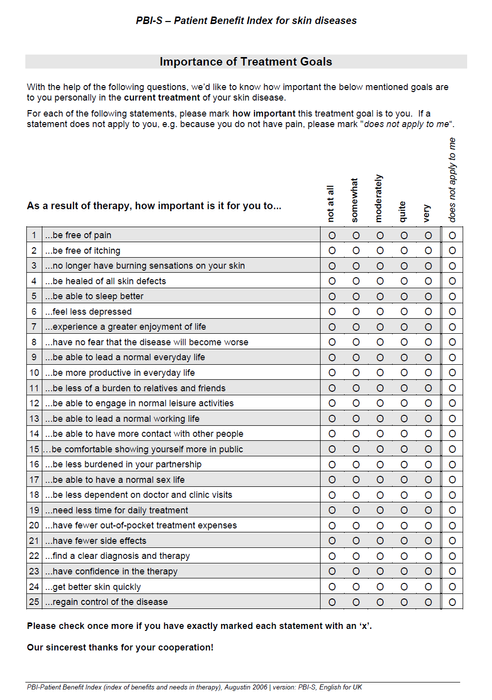
Before therapy, the patient fills in the standardised ”Patient Needs Questionnaire“ on the individual importance of treatment objectives. This reflects his personal preferences with respect to therapeutic benefit.
During or after therapy, the patient rates the extent to which the treatment objectives have been achieved in the ”Patient Benefit Questionnaire“.
A global score, the PBI in the narrower sense, is calculated for each patient by weighing the achievement values of the treatment objectives by their importance to the individual patient.
Development
The PBI standard version (PBI-S) for use in all skin diseases was developed at the CVderm, University Medical Center Hamburg-Eppendorf. An open survey of n = 100 patients with acute or chronic skin diseases and n = 23 dermatologists yielded an item pool of 213 potentially relevant items. These were reduced to 23 items including only benefits repeatedly mentioned by the patients. Validity of the PBI-S has been confirmed in validation studies on more than 6,000 patients. Two more items were added in the course of further development of the PBI-S, resulting in a total number of 25 items (this extended version was validated in Feuerhahn et al. 2012, doi: 10.1007/s00403-012-1256-y.)
Versions and languages
In addition to the PBI standard version (PBI-S) for use in all skin diseases, a range of disease-specific PBI versions have been developed.
Translations of PBI versions have been performed as follows:

Independent translations by 2 native speakers

Independent back-translations by 2 German native speakers

Tabulation of all translations (sentence by sentence) with listing of all differences between translations and differences between back translations and original

Translators' and methodologists'/ authors' conference to find a consensus on the final translation
proof reading the final questionnaire by native speaker.
The following PBI versions and languages are available:
Conditions
Acne vulgaris
Atopic eczema
Autoimmune skin diseases
Hair diseases
Hand and foot eczema
Herpes zoster
Hyperhidrosis
Psoriasis vulgaris
Ulcus cruris
Urticaria
Number of items
25
Publication
Validation (different skin diseases): Augustin M, Radtke MA, Zschocke I, Blome C, Behechtnejad J, Schäfer I, Reusch M, Mielke V, Rustenbach SJ: The patient benefit index: a novel approach in patient-defined outcomes measurement for skin diseases. Arch Dermatol Res 301(8):561-71, 2009
Validation (psoriasis): Feuerhahn J, Blome C, Radtke MA, Augustin M. Validation of the Patient Benefit Index for the Assessment of Patient- Relevant Benefit in the Treatment of Psoriasis. Arch Dermatol Res 304 (6):433-41, 2012
Validation (acne vulgaris): Augustin M, Reich C, Schaefer I, Zschocke I, Rustenbach SJ: Entwicklung und Validierung eines neuen Instrumentes zur Erfassung patientendefinierten Nutzens in der Therapie der Akne. J Dtsch Dermatol Ges 6(2): 113–20, 2008. --- Article is also available in English (Development and validation of a new instrument for the assessment of patient-defined benefit in the treatment of acne).
Subscales: Blome C, Augustin M, Behechtnejad J, Rustenbach SJ: Dimensions of Patient Needs in Dermatology: Subscales of the Patient Benefit Index. Arch Dermatol Res 303(1), 11-17, 2011
Electronic version (ePBI): Otten M, Djamei V, Augustin M. Development, Feasibility, and Acceptability of the Electronic Patient Benefit Index for Psoriasis in Clinical Practice: Mixed Methods Study. JMIR Dermatol. 2024 Aug 9:7:e54762
Available languages
Chinese (Taiwan), Croatian (Croatia), Czech (Czech Republic), Danish (Denmark), Dutch (Netherlands), Dutch (Belgium), English (Australia), English (Canada), English (UK), English (USA), French (Canada), French (France & Belgium), French (Switzerland) German (Austria), German (Germany), German (Switzerland), Greek (Greece), Hungarian (Hungary), Indonesian (Indonesia), Italian (Italy), Italian (Switzerland), Japanese (Japan), Korean (Korea), Polish (Poland), Portuguese (Brazil), Russian (Russia), Slovenian (Slovenia), Spanish (Spain), Spanish (USA), Swedish (Sweden), Turkish (Turkey), Ukrainian (Ukraine)
Conditions
As PBI-S, see above
Number of items
10
Publication
Blome C, von Stülpnagel C, Augustin M, Mrowietz U, Reich K, Muehlan H, Kirsten N, Langenbruch A, Sorbe C, Klein TM (2022). Measuring patient-relevant benefits in psoriasis with the Patient Benefit Index: Development and preliminary validation of a 10-item short form. Br J Dermatol 187(4):588-589
Available languages
As PBI-S, see above, plus: Portuguese (Portugal)
Conditions
• Atopic dermatitis
• Psoriasis
• Ulcus cruris
• Vitiligo
Number of items
12
Publication
Topp J, Augustin M, von Usslar K, Gosau R, Reich K, Reusch M, Blome C (2018). Measuring Patient Needs and Benefits in Dermatology using the 'Patient Benefit Index 2.0' – A Validation Study. Acta Derm Venereol. 99(2):211-7, 2019
Available languages
English (UK), German (Germany), Japanese (Japan)
Conditions
Acne inversa / Hidradenitis suppurativa
Number of items
26
Publication
Kirsten N, Augustin M, Blome C, Topp J, Schwager R, Bechara FG, Girbig G, Pinter A, Anzengruber F, Lindegaard M, Zouboulis CC, Otten M. Development and Validation of a Disease-specific Outcomes Tool for the Assessment of Patient Benefits of Treatment for Hidradenitis Suppurativa: the PBI-HS. Acta Derm Venereol. 2025 Mar 6;105:adv41298
Available languages
German (Germany)
Conditions
Acne vulgaris in adolescents
Number of items
14
Publication
-
Available languages
German (Germany)
Conditions
Actinic keratosis
Number of items
8
Publication
-
Available languages
German (Germany)
Conditions
Aged skin
Number of items
20
Publication
Lohrberg D, Blaak J, Liebsch J, Staib P, Wohlfart R, Lüttje D, Schürer NY, Augustin M, Blome C. Development and Validation of the Patient Benefit Index for the Dermatocosmetic Treatment of Aged Skin Arch Dermatol Res 308(5):319-24, 2016PBI-AR: Allergic rhinitis
Available languages
German (Germany)
Conditions
Allergic rhinitis
Number of items
25
Publication
Franzke N, Schäfer I, Jost K, Blome C, Rustenbach SJ, Reich K, Reusch M, Maurer M, Augustin M: A new instrument for the assessment of patient-defined benefit in the treatment of allergic rhinitis. Allergy. 66(5):665-70, 2011
Demoly P, Aubier M, de Blay F, Wessel F, Clerson P, Maigret P: Evaluation of patients' expectations and benefits in the treatment of allergic rhinitis with a new tool: the patient benefit index - the benefica study. Allergy Asthma Clin Immunol. 11(1):8, 2015
Available languages
German (Germany), Russian (Russia), Dutch (Netherlands), Italian (Italy), French (France), Spanish (Spain), English (UK), Polish (Poland)
Conditions
Allergic rhinitis in children
Number of items
19
Publication
Janke TM, Eisner E, Augustin M, Blome B: Development and validation of a tool for the assessment of benefit from treatment of allergic rhinitis in children and adolescents (PBI‑AR‑K). Allergy Asthma Clin Immunol. 18:95, 2022
Available languages
German (Germany). English (UK)
Conditions
Allergic rhinoconjunctivitis: special version for treatment with Allergen Immunotherapy
Number of items
33
Publication
Langenbruch A, Wüstenberg E, Wolf H, Augustin M. Development and Validation Features of the Patient Benefit Index for the Treatment of Allergic Rhinoconjunctivitis with Allergen Immunotherapy. Journal of Asthma and Allergy. 15: 611–621, 2022
Available languages
German (Germany)
Conditions
Asthma bronchiale
Number of items
26
Publication
-
Available languages
German (Germany)
Conditions
Atopic dermatitis in children
(to be filled in by child or parents, depending on the child’s age)
Number of items
23
Publication
-
Available languages
German (Germany), Russian (Russia), Dutch (Netherlands), Italian (Italy), French (France), Spanish (Spain), English (UK), Polish (Poland)
Conditions
Chronic hand eczema
Number of items
23
Publication
Blome C, Maares J, Diepgen T, Rustenbach SJ, Augustin M: Measurement of patient-relevant benefits in the treatment of chronic hand eczema – a novel approach. Contact Dermatitis. 61: 39-45, 2009
Available languages
German (Germany), Russian (Russia), Dutch (Netherlands), Italian (Italy), French (France), Spanish (Spain), English (UK), Polish (Poland)
Conditions
Chronic lymphocytic leukaemia
Number of items
29
Publication
Hester B, Tresckow JV, Voigtländer M, Beckmann H, Rusch J, Blome C. Development of a modular patient-reported outcome and experience measure on patient needs and benefits in CLL (PBI-CLL). J Patient Rep Outcomes 9(1):45, 2025
Available languages
German (Germany), English (UK)
Conditions
Chronic wounds
Number of items
22
Publication
Augustin M, Blome C, Zschocke I, Schäfer I, Koenig S, Rustenbach SJ, Herberger K: Benefit evaluation in the therapy of chronic wounds from the patients' perspective-development and validation of a new method. Wound Repair Regen: 20(1):8-14, 2012
Available languages
German (Germany), Russian (Russia), Dutch (Netherlands), Italian (Italy), French (France), Spanish (Spain), English (UK), Polish (Poland)
Conditions
Chronic wounds, special version for evaluation of ultrasound treatment
Number of items
24
Publication
Instrument was used in:
Herberger K, Franzke N, Blome C, Kirsten N, Augustin M: Efficacy, Tolerability and Patient Benefit of Ultrasound-Assisted Wound Treatment versus Surgical Debridement: A Randomized Clinical Study. Dermatology: 222(3):244-9, 2011
Available languages
German (Germany), Italian (Italy), French (France), Spanish (Spain), English (UK), Polish (Poland)
Conditions
Cosmetic indications
Number of items
24
Publication
Augustin M, Schäfer I, Rabini S, Lee-Seifert C, Radtke M, Rustenbach SJ: Assessing the value of supportive skin care: development and validation of an instrument for evaluating patient-relevant benefit. Dermatology 218(3):255-9, 2009
Available languages
German (Germany), Russian (Russia), Dutch (Netherlands), Italian (Italy), French (France), Spanish (Spain), English (UK), Polish (Poland)
Conditions
Dental treatment: Caries treatment
Number of items
18
Publication
-
Available languages
German (Germany)
Conditions
Dental treatment: Professional tooth cleaning
Number of items
16
Publication
-
Available languages
German (Germany)
Conditions
Epilepsy, version for drug treatment
Number of items
21
Publication
Janke TM, Cuny J, Blome C, Wittig-Moßner D, Hamer H. Development of a questionnaire to measure patient-relevant needs and benefits in the treatment of epilepsy (PBI-Epilepsy). Epilepsy Behav 162:110152, 2024
Available languages
German (Germany), English (UK)
Conditions
Epilepsy, version for surgery
Number of items
21
Publication
Janke TM, Cuny J, Blome C, Wittig-Moßner D, Hamer H. Development of a questionnaire to measure patient-relevant needs and benefits in the treatment of epilepsy (PBI-Epilepsy). Epilepsy Behav 162:110152, 2024
Available languages
German (Germany), English (UK)
Conditions
Hyperhidrosis
Number of items
21
Publication
Instrument was used in:
Müller C, M Augustin. Willingness-to-pay and patient-defined benefits in the treatment of hyperhidrosis: results from the first German health services research study in hyperhidrosis. Br J Dermatol 68(2):448-50, 2013
Available languages
As PBI-S, see above
Conditions
Interstitial cystitis
Number of items
22
Publication
-
Available languages
German (Germany), Polish (Poland)
Conditions
Lymphedema
Number of items
23
Publication
Blome C, Augustin M, Heyer K, Knöfel J, Cornelsen H, Purwins S, Herberger K: Evaluation of patient-relevant outcomes of lymphedema and lipedema treatment: development and validation of a new benefit tool. Eur J Vasc Endovasc Surg 47(1):100-7, 2013
Duygu E, Bakar Y, Keser I. An Important Tool in Lymphedema Management: Validation of Turkish Version of the Patient Benefit Index-Lymphedema. Lymphat Res Biol 18(1):49-5, 2020
Available languages
German (Germany), English (UK), Turkish (Turkey), Polish (Poland)
Conditions
Multiple sclerosis
Number of items
27
Publication
Beckmann H, Augustin M, Heesen C, Poettgen J, Blome C: Benefit evaluation in multiple sclerosis relapse treatment from the patients' perspective - Development and validation of a new questionnaire. Mult Scler Relat Disord. 28:256-61, 2019
Available languages
German (Germany)
Conditions
Nail psoriasis
Number of items
24
Publication
Augustin M, Blome C, Costanzo A, Dauden E, Ferrandiz C, Girolomoni G, Gniadecki R, Iversen L, Menter A, Michaelis-Wittern K, Morita A, Nakagawa H, Reich K: Nail Assessment in Psoriasis and Psoriatic Arthritis (NAPPA): Development and Validation of a Tool for Assessment of Nail Psoriasis Outcomes. Br J Dermatol 170:591-8, 2014
Available languages
German (Germany), Italian (Italy), Spanish (Spain), English (UK), Portuguese (Portugal), Greek (Greece), Danish (Denmark), Japanese (Japan), Polish (Poland)
Conditions
Neurofibromatosis
Number of items
28
Publication
-
Available languages
German (Germany), English (UK), Polish (Poland)
Conditions
Peripheral artery disease
Number of items
12
Publication
Zander N, Demirel EB, Augustin M, Sommer R, Debus ES, Breuer P, Blome C. Development and validation of the Patient Benefit Index for peripheral arterial disease. VASA 47(3):219-226, 2018
Available languages
German (Germany), English (UK)
Conditions
Pruritus
Number of items
27
Publication
Blome C, Augustin M, Siepmann D, Phan NQ, Rustenbach SJ, Ständer S. Measuring patient-relevant benefits in pruritus treatment: development and validation of a specific outcomes tool. Br J Dermatol 161(5):1143-8, 2009
Available languages
German (Germany, Austria), Russian (Russia), Dutch (Netherlands), Italian (Italy), French (France), Spanish (Spain), Spanish (USA), English (UK), English (USA), Polish (Poland)
Conditions
Psoriatic arthritis
Number of items
21
Publication
Manuscript in preparation
Available languages
German (Germany)
Conditions
Rehabilitation of dorsopathy (unspecified at multiple sites in spine)
Number of items
16
Publication
Validation study ongoing
Available languages
German (Germany)
Conditions
Rehabilitation after hip or knee endoprothesis
Number of items
14
Publication
Validation study ongoing
Available languages
German (Germany)
Conditions
Rheumatoid arthritis
Number of items
20
Publication
-
Available languages
German (Germany)
Conditions
Rosacea
Number of items
23
Publication
Augustin M, Sommer R, Blome C, Kirsten N, Langenbruch A (2023). Development of a Specific Variant of Patient Benefit Index (PBI) Assessing Patient Needs, Goals and Benefits in Rosacea Treatment. Pat Pref Adher 17:1335-1345
Available languages
German (Germany), Russian (Russia), Dutch (Netherlands), Italian (Italy), French (France), Spanish (Spain), English (UK), Polish (Poland)
Conditions
Topical treatment of skin diseases
Number of items
21
Publication
Blome C, Hülswitt L, Meineke A, Augustin M, Ohm F, Rusch J, Janke TM (2024). Goals and benefits in topical treatment for psoriasis: development and pilot validation of a patient-reported outcomes tool, the Patient Benefit Index for Topical Treatment (PBI-TOP). Br J Dermatol 2024 Jan 12:ljad484
Available languages
German (Germany), Italian (Italy), French (France), Spanish (Spain), English (UK)
Conditions
Venous diseases
Number of items
23
Publication
-
Available languages
German (Germany), Russian (Russia), Dutch (Netherlands), Italian (Italy), French (France), Spanish (Spain), English (UK), Polish (Poland)
Conditions
Vitiligo
Number of items
26
Publication
Augustin M, Gajur AI, Reich C, Rustenbach SJ, Schaefer I. Benefit Evaluation in Vitiligo treatment: Development and Validation of a Patient-Defined Outcomes Questionnaire. Dermatology 217: 101-106, 2008
Available languages
German (Germany), Russian (Russia), Dutch (Netherlands), Italian (Italy), French (France), Spanish (Spain), English (UK), Polish (Poland)
Instructions
The PBI is filled in by the patients themselves. The questionnaire is self-explanatory; yet, patients can be supported if they are not able to fill it in by themselves. In this case, the support has to be documented.
The PBI can be accessed via internet, i.e. patients can fill it in on a website. The following has to be considered:
The instructions are the same as in the paper version, except for the phrase ”Please check whether you have marked each statement exactly once“ which is omitted in both PNQ and PBQ. The website needs to be programmed so that the patient can send the data (or get to the next part of the survey) only after responding to each item.
Ideally, all PNQ items are given on one page and are thus visible to the patient on the same page. Equally, all PBQ items are given on one page.
The website layout should equal the paper layout as far as possible. In particular, the option ”does not apply to me“ needs to be visually separated from the other options.
Data analysis
The data are coded with numbers (0 to 4; ”does/did not apply to me“ = 5; missing value = -9) and are entered into a spreadsheet (e.g. Excel) or statistics program (e.g. SPSS). The spreadsheet matrix should be structured as follows: Each row corresponds with one patient and each column corresponds with one variable (=item).
If an item is answered with two or more "x" or by ticking between two checkboxes, it will be treated as missing.
Part 1
Patient Needs Questionnaire (PNQ). The PNQ consists of the treatment goal items. It is analyzed descriptively. The analysis can include:
means and standard deviations of all items („does not apply to me“ is coded as 0 for this single-item analysis of the PNQ)
for each item the percentage of the response „does not apply to me“
for each item the percentage of responses with high agreement (quite or very)
percentage of missing values
Part 2
Patient Benefit Questionnaire (PBQ). The PBQ consists of the benefit items measuring the extent to which the treatment goals have been achieved. It is analyzed descriptively. The analysis can include:
means and standard deviations of all items („did not apply to me“ being treated as missing here!)
for each item the percentage of the response „did not apply to me“
for each item the percentage of responses with high agreement (quite or very)
percentage of missing values
The global score PBI is computed for each patient according to the following algorithm. Using this algorithm, the importance of each treatment goal is divided by the sum of all importance values of the respective patient and is multiplied with the goal attainment value. The resulting products are added up.
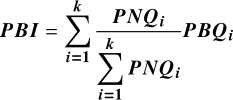
Algorithm for the computation of the PBI global benefit value with k preference items (PNQ) and benefit items (PBQ); possible range of item values and global score values: 0-4.
Algorithm for the computation of the PBI global benefit value with k preference items (PNQ) and benefit items (PBQ); possible range of item values and global score values: 0-4.
For score calculation, both “does/did not apply” and “question unanswered” will be treated as missing values. The global score will be calculated using only those items pairs (i.e., importance item and benefit item) for which the patient has given a response other than “does/did not apply” in both PNQ and PBQ. In other words, importance items for which the corresponding benefit item has been rated as “did not apply” (or vice versa) will not be included in the sum of needs (i.e. the denominator within the algorithm).
Furthermore, subscales of the PBI-S (and for some further PBI versions, too) can be calculated representing different dimensions of treatment benefit. Therefore, the algorithm (see above) is applied to the items of the respective scale. The subscales include the following items (Blome C, Augustin M, Behechtnejad J, Rustenbach SJ: Dimensions of Patient Needs in Dermatology: Subscales of the Patient Benefit Index. Arch Dermatol Res 303(1), 11-17, 2011):
PBI global score and subscales may only be computed if the patient has provided valid data on importance (PNQ) and benefit (PBQ) for at least 75% of the respective treatment goals. In this context, the responses “not at all” and “does/did not apply” count as valid data. Thus, a treatment goal is regarded missing if the patient has not responded to the item in the PNQ and/or in the PBI.
Psychometric properties
The PBI-S is the most widely used PBI version.
The following data are from the PBI-S validation Augustin M, Radtke MA, Zschocke I, Blome C, Behechtnejad J, Schäfer I, Reusch M, Mielke V, Rustenbach SJ: The patient benefit index: a novel approach in patient-defined outcomes measurement for skin diseases. Arch Dermatol Res 301(8):561-71, 2009).
Cross-sectional validation in n = 500 patients with 10 distinct skin diseases (50 patients of each of the following diseases: acne vulgaris, atopic eczema, autoimmune diseases of the skin, hand and foot eczema, hair diseases, herpes zoster, hyperhidrosis, psoriasis, ulcus cruris, urticaria). PNQ and PBQ were filled in consecutively with the instruction to rate achieved benefits of the most recently completed therapy.
The PNQ was highly reliable/consistent (Cronbach’s alpha = 0.91; part-whole corrected item-total correlations 0.32 to 0.68).
High convergent validity was found with respect to treatment success in 6 areas as rated by the patient: physical well-being: r = 0.76; emotional well-being: r = 0.69; performance capacity on the job and in everyday living: r = 0.54; social contacts: r = 0.53; leisure activities: r = 0.53; quality of life: r = 0.71 (all p < 0.001).
The PBI discriminates well between different diagnoses: Disease-specific, clinically recognizable patterns of patient-defined needs were found (MANOVA: p < 0.001).
Longitudinal validation in a treatment study in clinical practice on n = 906 patients with acne vulgaris. The PNQ was recorded at T1 (therapy onset), the PBQ at both T2 (ca. 4 weeks after therapy onset) and at T3 (after 8-12 weeks) under practice conditions
The PBI is sensitive to change: The percentage of treatment objectives that had been achieved quite or very well increased from 49.5% at T2 to 62.3% at T3.
Under practice conditions, there were between 0.2 and 1.7% missing values, depending on the item.
Median convergent validity (r=0.35, p<0.001) was found with change in the acne-specific quality of life questionnaire “Acne Disability Index“ (ADI).
Information on validity of the single PBI versions can be found in the respective publications, see "VERSIONS"
Interpretation
We suggest the following interpretation of the PBI global score, in line with the PBI response scale:
0 to <1
No meaningful patient benefit
1- <2
Some patient-relevant benefit
2 - <3
Moderate patient-relevant benefit
3 - 4
Large patient-relevant benefit
We suggest to use 1.0 as the threshold for clinically relevant patient benefit, that is, patients with a PBI global score ≥ 1 can be interpreted as more than marginal benefit.
If you would like to use any of our tools within your project or study, please use the button to the right to be taken to our licensing form. Thank you.
Downloads
Contact us
An error occurred submitting the form. Please try again.
Submitting...
Thank you!
Your message has been submitted. We will reply as soon as possible.
This website uses cookies!

We use cookies to tailor our content to your needs and continuously improve our website. You can decide which cookies you want to allow. Detailed information about the cookies we use can be found in our Privacy Policy and Cookie Settings. You can withdraw your consent at any time.